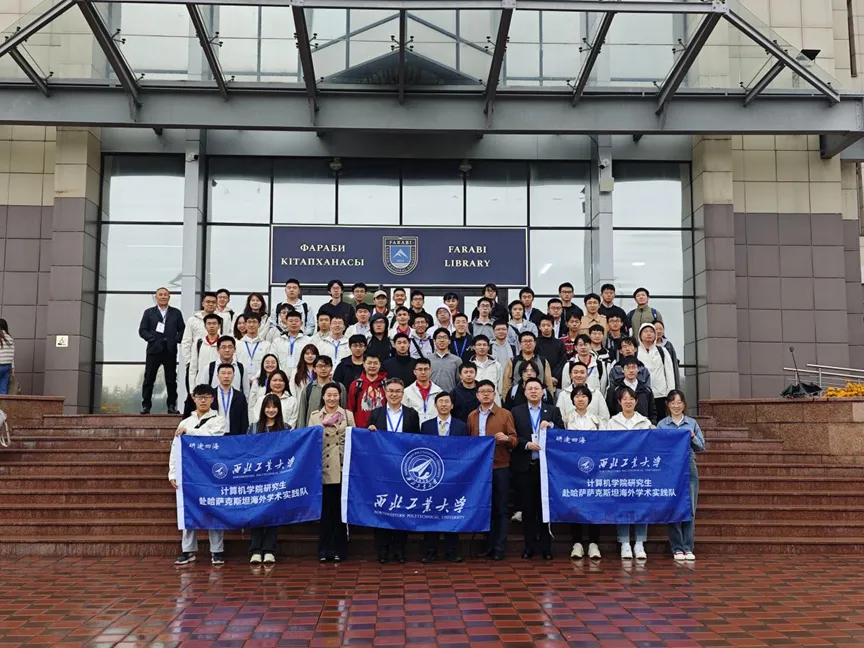
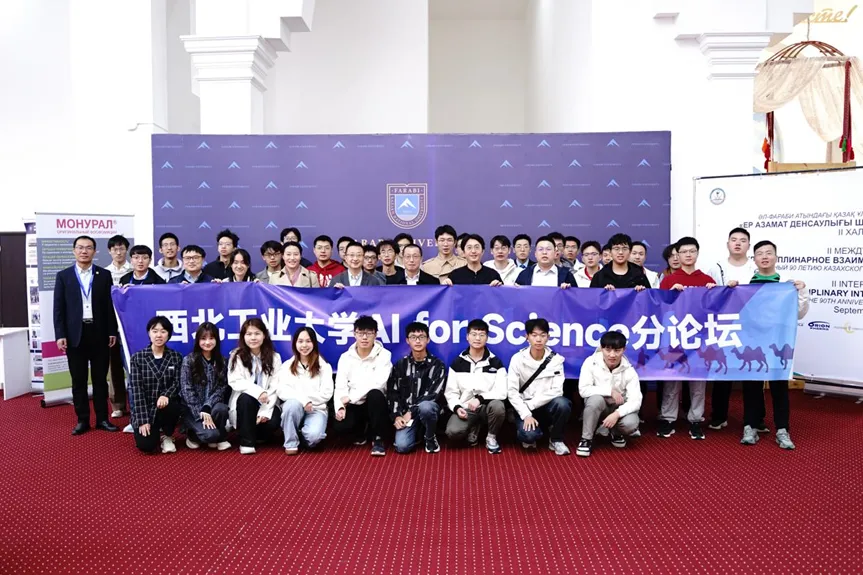
To thoroughly implement the spirit of General Secretary Xi Jinping's important instructions on running the Kazakhstan Branch of Northwestern Polytechnical University (NPU) well, with the guidance and support of the Graduate School, the Office of International Cooperation, and the Kazakhstan Branch, Xia Yong, Associate Dean of the School of Computer Science, Cui Helei, Assistant to the Dean, teacher representatives including Zhang Yu, Liu Zhaowen, Chen Bolin, Wang Xiaoqi, and Pan Yongsheng, along with 30 students, traveled to Al-Farabi Kazakh National University to celebrate its 90th anniversary. They successfully hosted the AI for Science Sub-Forum at the university’s "Belt and Road" International Conference on Advanced Materials Genomics and Intelligent Science. Professors Jia Xiaohua and Wang Cong from City University of Hong Kong were specially invited to participate in the sub-forum.
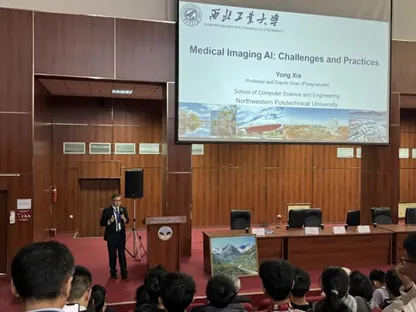
On the morning of September 26, the opening ceremony of the main conference was grandly held at the Red Lecture Hall of Al-Farabi Kazakh National University, presided over by Professor Nurzada Beissen, Dean of the University’s School of Physics and Technology. Professor Xia Yong delivered a keynote speech at the opening ceremony, introducing the challenges and practices of medical imaging and intelligent computing in the era of artificial intelligence to the participants, and sharing the latest progress of his team in related experimental work.
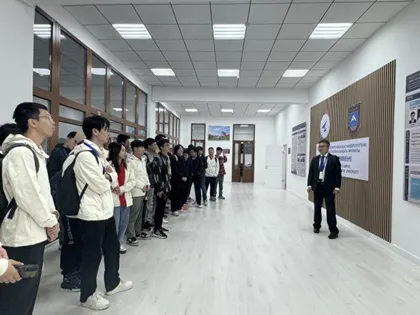
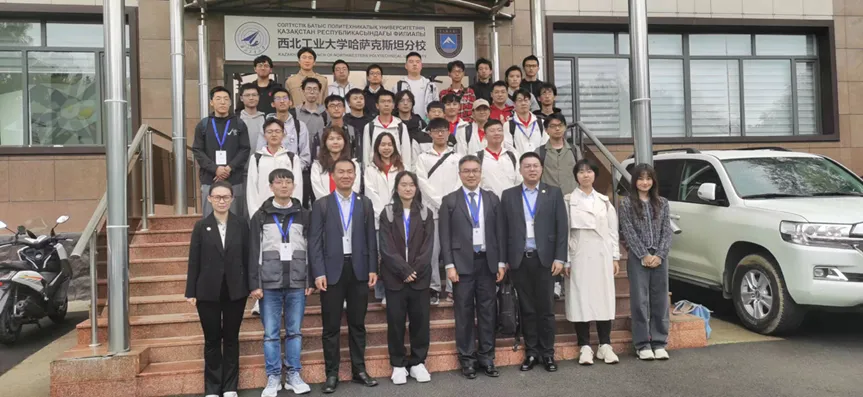
After the opening ceremony, Xia Yong led the students to visit the Kazakhstan Branch of NPU. During the visit, he detailed the background and important significance of the branch’s establishment, encouraging the students to become successors to China-Kazakhstan friendship, build profound friendships with students from the branch, strengthen academic exchanges, and make progress together.
On the 27th, the AI for Science Sub-Forum was held at the Lecture Hall of Al-Farabi Kazakh National University Library, hosted by Liu Zhaowen. In the first session of the sub-forum, themed reports were delivered by Jia Xiaohua, Wang Cong, Chen Bolin, Liu Zhaowen, Pan Yongsheng, as well as invited experts Jia Xiaohua and Wang Cong from Hong Kong. Professor Jia Xiaohua gave a speech titled Secure, Incentivized and Unlearning-enabled Data Sharing for Machine Learning in Decentralized Networks, focusing on how to achieve secure data sharing in decentralized networks and discussing incentive mechanisms and unlearning technologies in the data sharing process. He pointed out that with the rapid development of big data and artificial intelligence technologies, balancing data privacy protection with effective data utilization has become an urgent issue to address. His research findings not only provide new ideas for data sharing in decentralized networks but also offer valuable references for researchers in the field of machine learning. Professor Wang Cong delivered an excellent report titled A Brief Overview of Recent Red-Teaming Techniques for LLM, delving into the latest progress of red-teaming techniques for Large Language Models (LLMs). He elaborated on the concept of red-teaming, a method that tests and enhances system security by simulating attacker behaviors. Chen Bolin’s report introduced the use of network smoothing and gravity models to conduct in-depth research on driving factors related to cancer staging, proposing a new method to identify key factors in different cancer stages. Liu Zhaowen put forward an innovative data integration strategy, providing a scientific basis for the precise diagnosis and personalized treatment of mental illnesses. Pan Yongsheng discussed the realization of accurate circuit board segmentation and defect detection based on deep learning technologies; by integrating advanced deep learning algorithms, the accuracy and efficiency of circuit board defect identification have been significantly improved, bringing technological innovation to the industrial inspection field.
In the second session of the sub-forum, themed reports were given by students from our school: Wu Yifei, Han Yourui, and Wang Baiqing. Wu Yifei summarized the latest progress of federated learning in medical image analysis, classified existing federated learning methods from a system perspective, and provided a new "question-answer" paradigm for each category to explain the motivations and mechanisms of different federated learning methods in medical image analysis, while introducing existing benchmark medical image datasets used in federated learning. Han Yourui shared that through machine learning algorithms, specific immune cell infiltration in early lung adenocarcinoma was found to be significantly different from normal samples, providing potential research targets for the prevention and early intervention of lung adenocarcinoma and enabling early diagnosis for patients. Wang Baiqing explained a new ear-worn system called EarPass, which uses features extracted from intra-ear photoplethysmography (PPG) signals for identity verification. This portable and cost-effective ear-worn continuous identity verification system based on PPG provides a security solution for ear-worn devices. Scholars at the meeting shared the latest progress in their respective research fields, and the innovative insights and research results presented sparked enthusiastic discussions among participants, further promoting interdisciplinary exchange and integration.
The holding of this sub-forum coincides with the era of educational globalization and the deepening educational cooperation between China and Kazakhstan. It reflects the close cooperation and in-depth exchange between the two sides in scientific research and education, marking a new stage in the collaboration between the two universities in cutting-edge science and technology and academic fields, and further advancing cross-border cooperation and innovative exploration in artificial intelligence and scientific research. This event not only demonstrated the academic strength of the two universities in related research fields but also deepened cooperation between China and Kazakhstan in education and scientific research. The successful holding of the conference signifies that the educational and technological cooperation between the two universities has reached a new height in the context of globalization, laying a solid foundation for deeper cooperation in the future, becoming a new milestone in international cooperation between universities of China and Kazakhstan, and setting an example for international educational exchanges.