To steadily advance the construction of first-class disciplines and a first-class school, and enhance internationalization, the School of Computer Science successfully held the 2025 Summer International Program from June 23 to July 13, 2025. This program invited renowned experts and professors from prestigious universities including Belarusian State University, Nanyang Technological University (Singapore), Griffith University (Australia), and The Chinese University of Hong Kong. Centering on cutting-edge fields such as artificial intelligence, big data, and integrated circuits, 12 international summer courses including Computer Vision and AI were offered, providing students with an international learning environment while further consolidating strategic cooperative relations with world-class universities.
This course specially invited Professor Sergey V. Ablameyko, Academician of the National Academy of Sciences of Belarus and former Rector of Belarusian State University. Over the two-day course, drawing on his profound theoretical knowledge and practical experience, Professor Ablameyko explained data preprocessing, model construction, image/video analysis skills, and interdisciplinary application knowledge of artificial intelligence in a simple and understandable way. He encouraged students to actively participate in classroom discussions and put forward their own questions and insights.
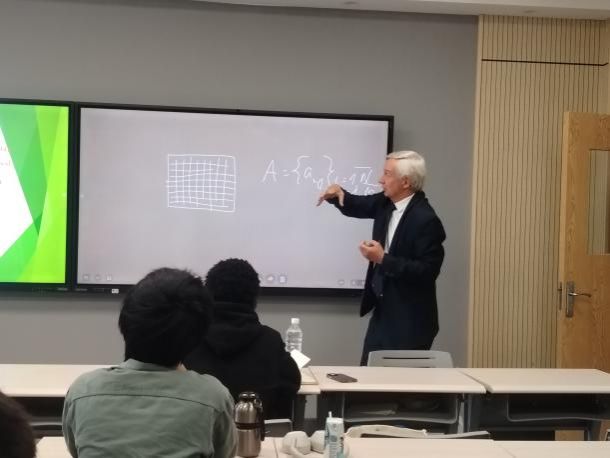
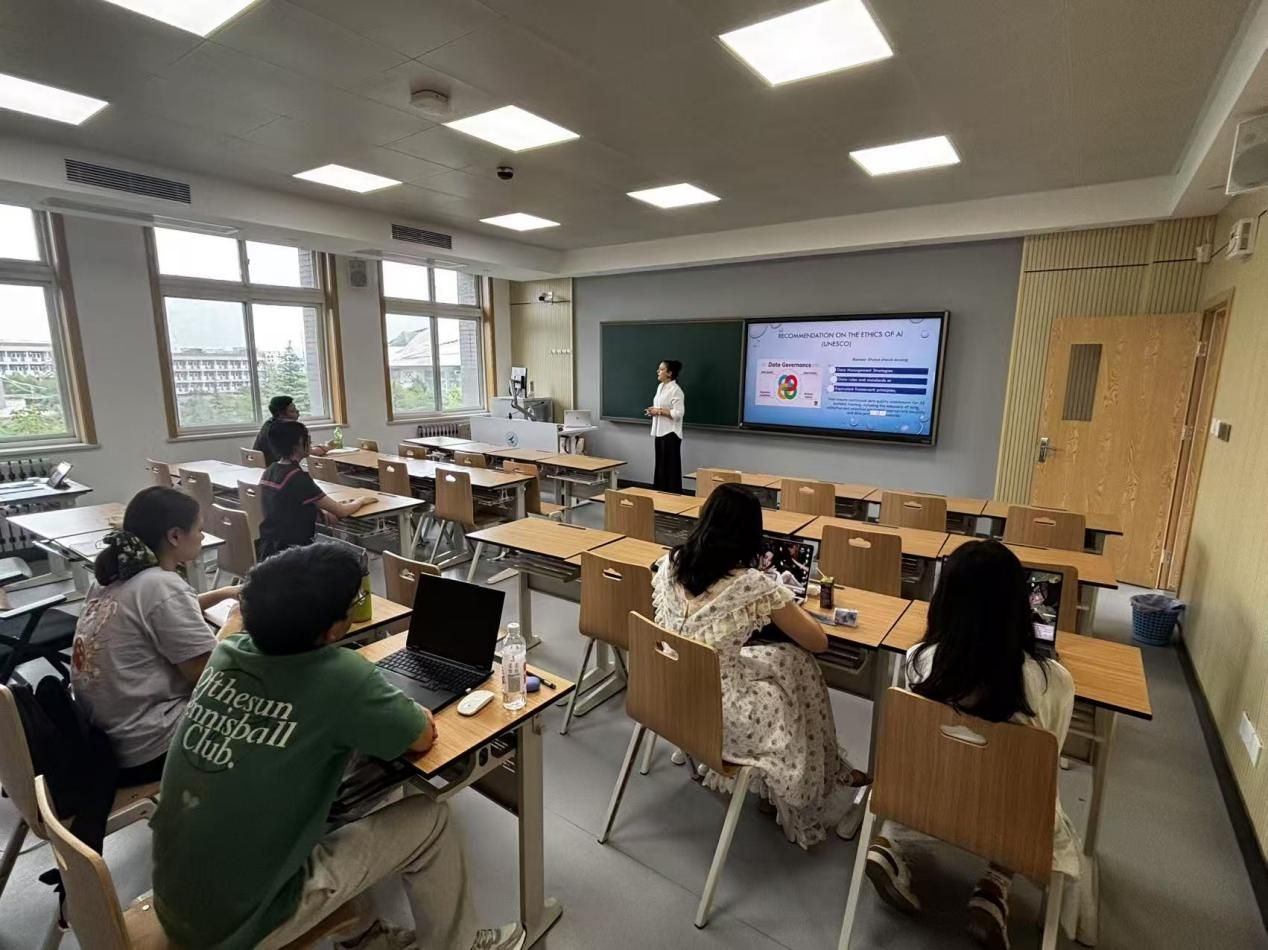
Associate Professor Maria Ablameyko from Belarusian State University taught the course Digital Law. By introducing cutting-edge content at the intersection of artificial intelligence and law, Maria focused on discussing legal issues related to digital countries, e-government, smart cities, AI governance, cybersecurity, and personal data protection with students. During the course, students in-depth studied the legal regulation of AI, data privacy protection, and cross-border legal comparisons, enhancing their ability to analyze legal issues arising from AI. They not only learned to identify and assess legal risks brought by AI but also to propose practical solutions based on specific scenarios. In addition, the course broadened students' perspectives on addressing cross-border legal differences and strengthened their comprehensive ability to use legal frameworks to solve practical problems in the context of the rapid development of digitalization and AI.
Taught by a professor from The Chinese University of Hong Kong, this course delved into the key technologies and application directions in the field of design automation for microfluidic biochips, aiming to analyze their inherent operating mechanisms and implementation paths. The course content included chip design automation algorithms, fluid manipulation and driving technologies, integrated solutions for biological sample processing, chip detection and analysis systems, as well as reliability and optimization strategies for automation systems. It helped students build a close bridge between technological research and development and practical biomedical applications.
Through specific project demonstrations and hands-on experimental operations, students mastered the core skills of constructing automated systems for microfluidic biochips, which not only improved the operational efficiency and detection accuracy of chips but also provided more efficient and precise technical support for fields such as biomedical diagnosis and drug screening. In addition, combining his years of research achievements, the instructor taught scientific research ideas in this field. The course not only helped students fully understand the research focus and future development trends of microfluidic biochip automation but also pointed out feasible paths and practical methods for their exploration and practice in related scientific research fields, facilitating a smoother start to their scientific research journey.
In the course Efficient Computing of Deep Neural Networks, the instructor, with profound professional knowledge, explained each efficient computing method from model compression and parallel computing to hardware acceleration in a simple and intuitive manner. Combining rich cases and cutting-edge research, complex theories were made easy to understand. In the classroom, students actively interacted and expressed their own opinions, sparking ideological collisions in the analysis of the advantages and disadvantages of model pruning strategies and discussions on the applicable scenarios of different parallel computing paradigms. Through this course, students not only mastered the core technologies of computational optimization but also broadened their academic horizons through exchanges and cooperation with teachers and classmates, laying a solid foundation for exploration in the field of efficient computing for deep learning.
This course in-depth explored the technical aspects involved in building trustworthy AI systems, aiming to reveal their basic principles and methodologies. The course content covered safety and robustness, fairness and bias, transparency and interpretability, privacy protection and data security, as well as relevant regulations and standards, helping students find a delicate balance between cutting-edge innovation and responsible development. Through real-case analysis and immersive practical operations, students mastered the core capabilities of building trustworthy AI systems, which not only effectively protect privacy and reduce bias but also establish a solid foundation of trust between users and stakeholders. In addition, combining his own scientific research experience, the instructor shared cutting-edge top international papers and in-depth taught how to conduct scientific research and write academically influential research papers. The course not only helped students deeply understand the current research hotspots and development trends in the academic community but also provided clear directions and effective methods for their practical exploration on the road of scientific research, helping them better take the first step in scientific research.
Professor Kwoh Chee Keong from Nanyang Technological University gave the course Data Analysis With AI. Focusing on the integration of AI technology and data analysis, this course aimed to cultivate students' ability to use advanced methods to solve practical problems and form data-driven thinking. Through the combination of theory and practice, the course focused on improving students' critical thinking, innovation ability, and teamwork spirit, laying the foundation for future data science talents. Through this course, students mastered the core ability of applying AI technology to data analysis and improved their skills in extracting valuable insights from data to solve practical problems. More importantly, they developed data-driven decision-making thinking and enhanced their critical thinking, innovative exploration, and teamwork abilities required in complex projects.
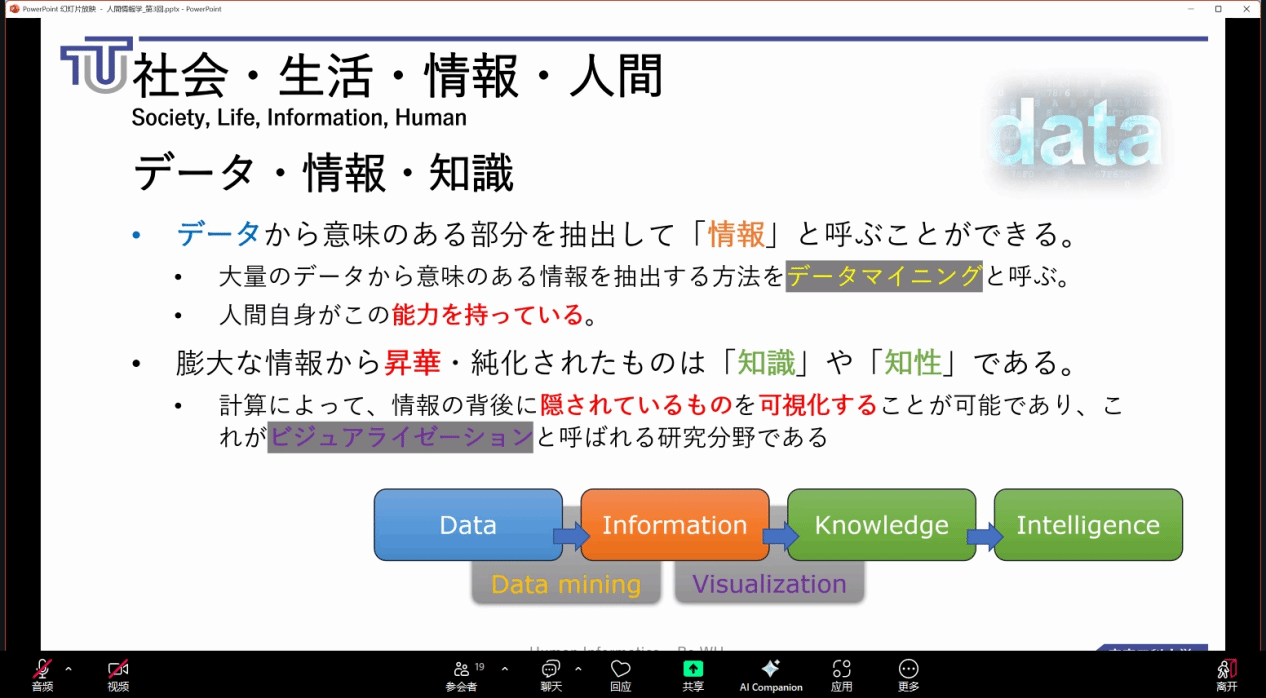
Dr. Takehiro Takeda from the Department of Computer Science, Tokyo University of Technology, has offered this course for four consecutive years, which is deeply loved by students. With his profound academic attainments, he brought a wonderful academic feast to the students. Starting from the connection between humans and information, Dr. Takeda in-depth explained the core connotation, research directions of human informatics, and its applications in various social fields. Combining interdisciplinary knowledge and practical cases, he clarified this complex academic field in an understandable way. During the exploration, students conducted in-depth thinking on topics such as human information processing mechanisms, human-computer interaction design, and technological and social applications, emerging many unique insights. Through the understanding of human informatics, students not only systematically mastered its main fields and application logic but also broadened their cognitive boundaries through the integration of multidisciplinary knowledge, laying a solid foundation for future practice and research in the interdisciplinary field of information technology and human society.
Ms. Irina Ualiyeva from Al-Farabi Kazakh National University taught Machine Learning and Natural Language Processing in the summer program. This course focused on introducing the application of machine learning in natural language processing. Through this course, students learned how to design, implement, and evaluate machine learning models for practical NLP tasks. Through coding exercises, small project design, and presentations, the course encouraged students to conduct critical thinking, innovation, and creativity when processing natural language data. In addition, the course also cultivated students' ability to effectively collaborate in team projects and encouraged them to try model variants and new data sources to enhance innovation.
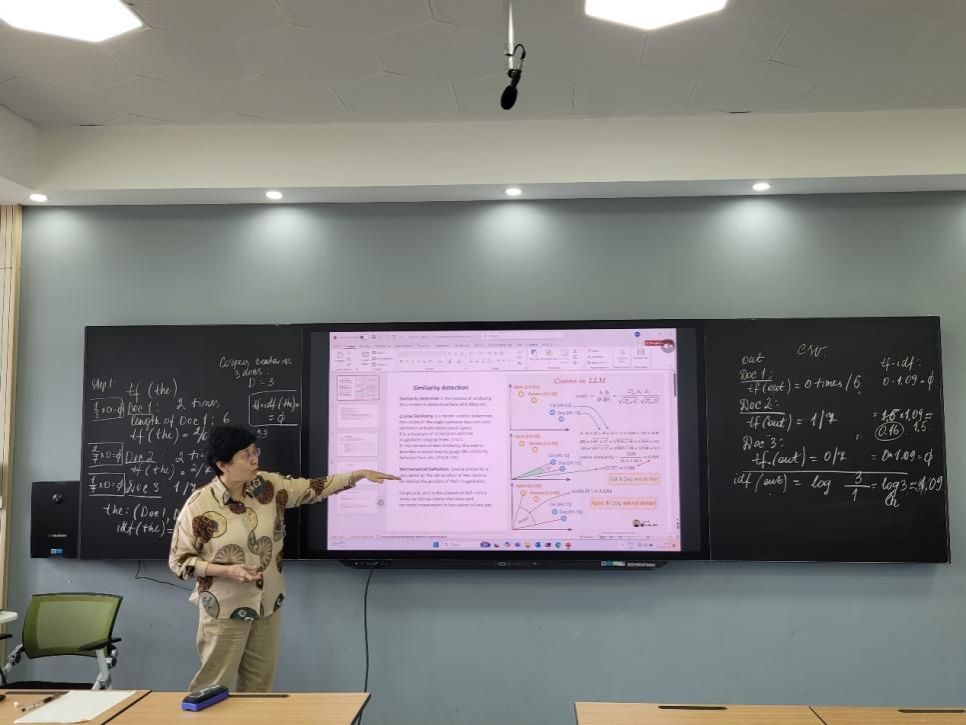
Ms. Symbat Kabdrakhova from Al-Farabi Kazakh National University taught Deep Learning Meets Physics in the summer program. This course systematically introduced Physics-Informed Neural Networks (PINNs), an emerging deep learning method, and explained how to integrate physical laws into the process of solving differential equations using machine learning.
The course introduced the modeling and solution methods for boundary value problems of two typical partial differential equations (PDEs): heat conduction and wave equations, with a focus on numerical solutions based on Physics-Informed Neural Networks (PINNs). Students learned how traditional numerical methods can be enhanced through machine learning models, thereby realizing the interdisciplinary integration of physics and data science. Through teacher's lectures and practical programming training, students mastered the modeling and solution of forward and inverse problems, with application fields including heat conduction, fluid dynamics, and renewable energy applications. After completing this course, students have gained the ability to develop PINN models, implement them using modern deep learning frameworks, and apply them to practical scientific and engineering problems.
In the summer course Mathematical Methods of AI in Medical Signal Processing, Ms. Zukhra Abdiakhmetova, Vice Dean of the School of Information Technology at Al-Farabi Kazakh National University, brought a wonderful academic feast to the students. Starting from the mathematical foundation of signal processing, she in-depth explained Fourier transform, convolutional neural networks, and their applications in medical signal processing. Combining practical cases and cutting-edge research, she explained complex mathematical methods in a simple and understandable way. In the classroom, students actively participated in discussions and had enthusiastic exchanges around topics such as signal denoising, feature extraction, and model optimization, sparking many innovative ideas. Through this course, students not only systematically mastered the core mathematical methods in medical signal processing but also broadened their research horizons through interactions with teachers and classmates, laying a solid foundation for future research in the interdisciplinary field of AI and medicine.
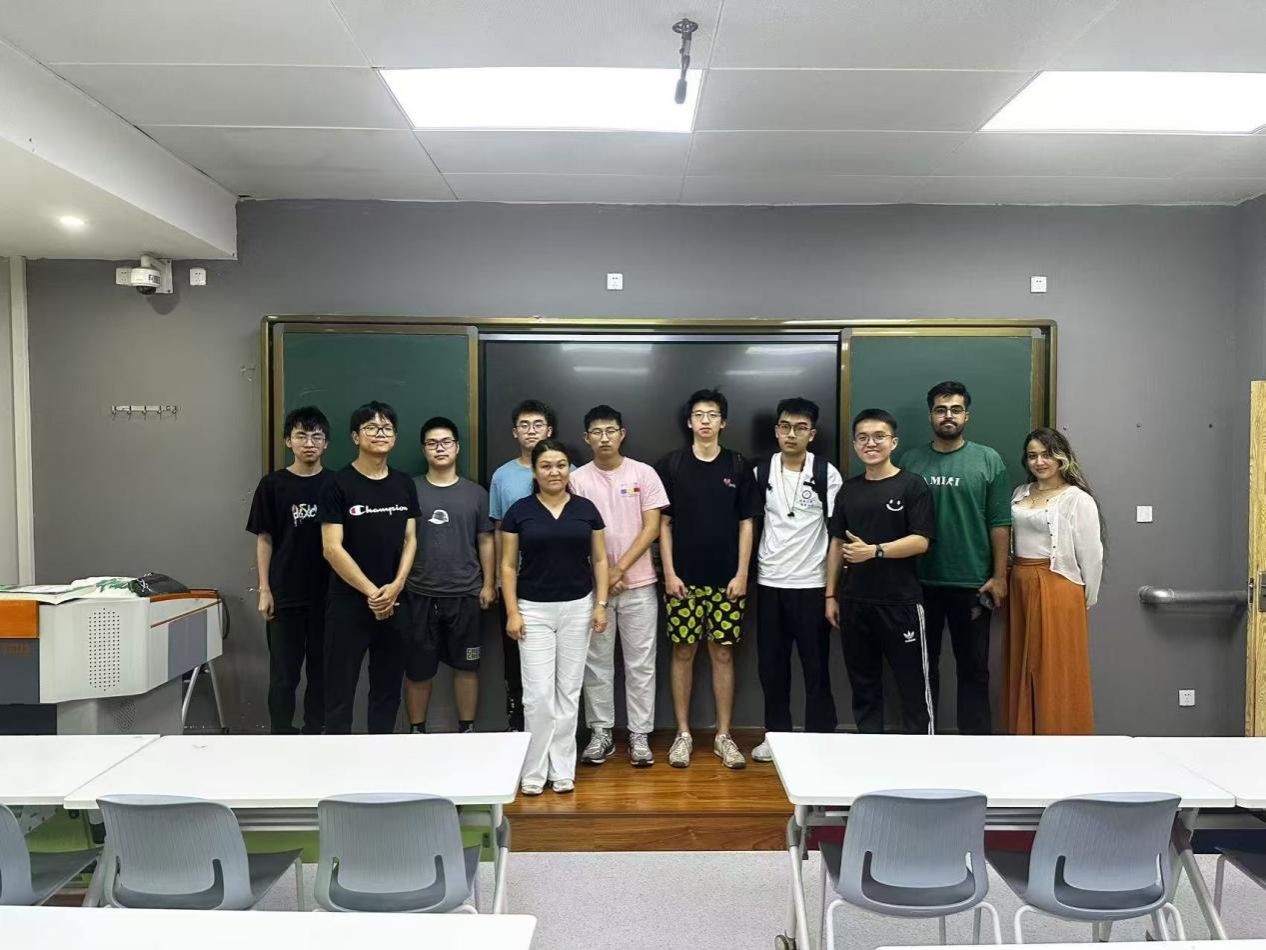
Starting from the basic concepts of database systems, this course systematically explained key contents such as data models, relational database design, SQL query language, transaction management, and security mechanisms. Combined with practical cases, it discussed the application scenarios and development trends of emerging technologies such as NoSQL in the era of big data. During the teaching process, Ms. Gulzat Turken focused on the combination of theory and practice. Through vivid explanations and interactive exercises, she guided students to deeply understand the three-level architecture of databases, the principle of data independence, and the practical application of relational algebra. In the SQL programming and database design sessions, she instructed students to complete group projects, helping them master the entire process from requirement analysis to standardized design and cultivating their ability to solve complex data management problems. In addition, the course integrated discussions on data security and ethics, enhancing students' sense of social responsibility and innovation through case analysis and group discussions.